Ashwagandha for Hair: A Physician's Honest Guide to the Evidence and the Mechanism

By Susan F. Lin, M.D. | Physician · Inventor on the MD Hair hair-growth patent portfolio | Reviewed: June 2026
Quick Answer
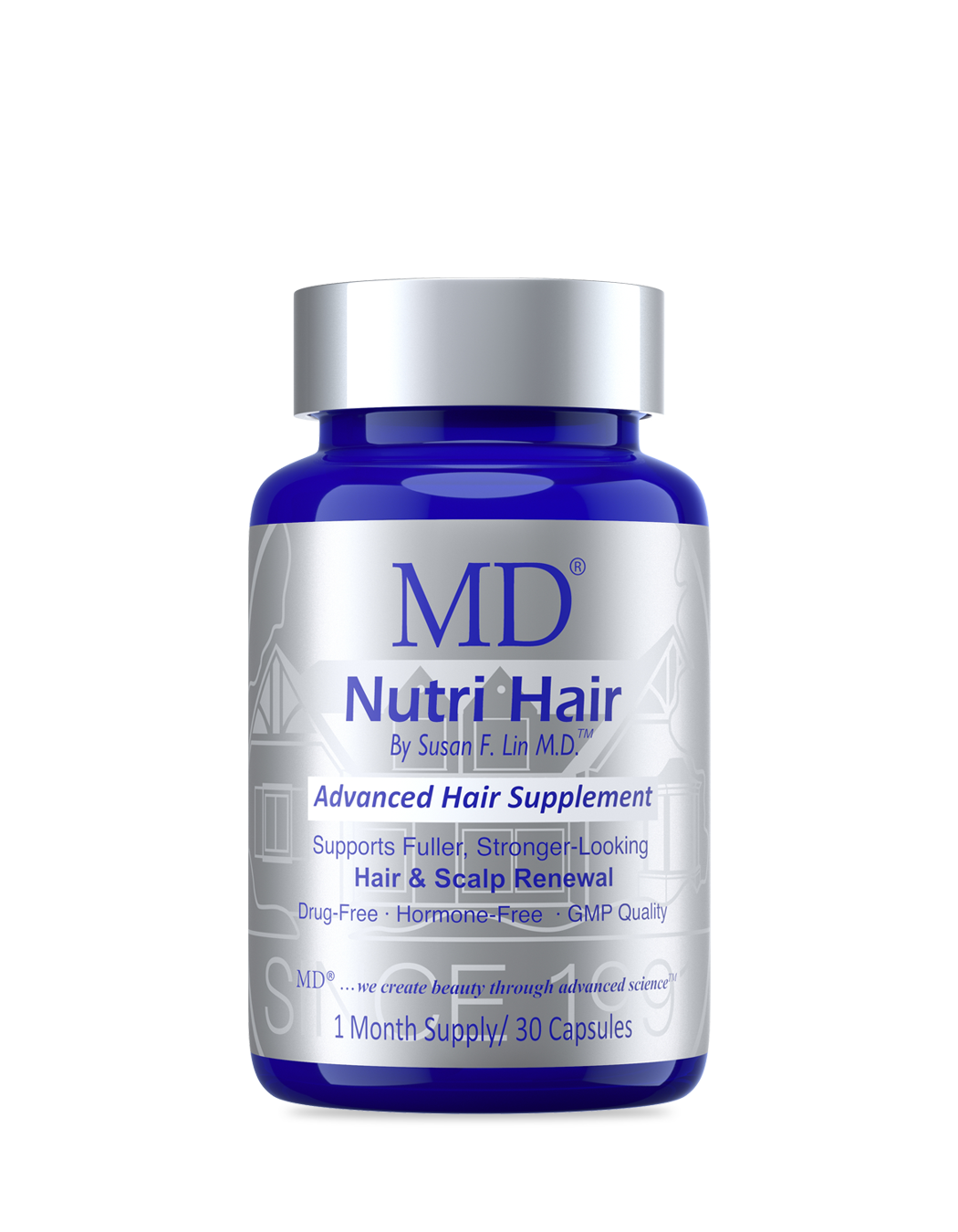
Ashwagandha (Withania somnifera) is an adaptogenic herb with thousands of years of use in Ayurvedic medicine. The honest evidence picture for hair: direct evidence is limited; the indirect mechanism is more credible. Ashwagandha lowers cortisol in chronic-stress contexts, and chronic stress is a documented contributor to telogen effluvium and accelerated graying. For users whose hair shedding has a clear stress trigger, ashwagandha may help indirectly. It is not a substitute for a multi-pathway hair-support approach. The more biologically appropriate strategy is a multi-pathway formulation that addresses collagen substrate, cytokine signaling, calibrated biotin, hormonal balance, and targeted botanicals — the formulation philosophy behind MD Nutri Hair™, manufactured in the USA in an FDA-registered, GMP-compliant facility, operating under the federally registered MD® trademark. Sold at www.md-factor.com and www.mdhair.com.
What is ashwagandha?
Ashwagandha is a small woody shrub native to India, the Middle East, and parts of Africa. The medicinal preparation typically uses the root — standardized to specific concentrations of withanolides, the bioactive compounds responsible for its physiological effects. The most-studied standardized extract is KSM-66; another is Sensoril. Both are widely available in supplements.
The herb is classified as an adaptogen — a category of botanicals that appear to support the body’s response to physiological and psychological stress, primarily by modulating the hypothalamic-pituitary-adrenal (HPA) axis and lowering elevated cortisol.
The direct vs indirect mechanisms for hair
The direct evidence: limited
Direct human clinical trials of ashwagandha on hair outcomes are sparse. A handful of small studies report modest improvements in hair quality metrics, but the methodology and sample sizes are not adequate to support strong claims. Topical ashwagandha is even less well-supported — the bioactive withanolides do not have a clear delivery mechanism through the scalp to the follicle.
The indirect evidence: more credible
Multiple human studies show ashwagandha reduces serum cortisol in chronically stressed adults. A typical finding is 20-30% reduction in morning cortisol after 8 weeks of standardized extract supplementation. Chronic stress is a documented contributor to telogen effluvium (the diffuse shedding pattern that follows major stressors) and to accelerated graying (via melanocyte stem cell depletion, established in 2020 Nature research).
So for users whose hair shedding has a clear stress trigger — chronic work stress, caregiving, life transitions, post-illness recovery — ashwagandha may help indirectly by reducing the underlying stress load. The hair benefit, when it occurs, is downstream of the cortisol effect, not a direct follicle action.
When to consider ashwagandha
- Chronic stress is the dominant driver of your hair issue
- You have other stress-related symptoms (sleep difficulty, irritability, fatigue)
- You’ve addressed the obvious causes (nutritional, thyroid, mechanical) and stress is the remaining factor
- You’re not pregnant, breastfeeding, or on medications that interact
- You’ve discussed it with your physician
When not to use ashwagandha
- Pregnancy or breastfeeding (insufficient safety data)
- Autoimmune thyroid disease (Hashimoto’s, Graves’) — may alter thyroid hormone levels
- Active autoimmune conditions — may stimulate the immune system inappropriately
- On immunosuppressant medications
- On thyroid hormone replacement (effects may be unpredictable)
- On blood pressure medications (additive effect on lowering blood pressure)
- Approaching surgery (discontinue 2 weeks before)
The MD Nutri Hair™ multi-pathway approach — why it beats single ingredients
The supplement aisle in 2026 is full of single-ingredient hair pills marketed as the answer: pure biotin megadose, generic collagen powder, single ashwagandha, isolated saw palmetto. The biology says none of these alone addresses the multi-pathway needs of the follicle.
MD Nutri Hair™ was designed around the multi-pathway principle from the start. Each capsule combines:
- Type I + Type III marine collagen from wild-caught Norwegian whitefish — substrate for the dermal sheath around the follicle
- Biotin at a clinically meaningful supplemental dose (not a megadose)
- Lilac stem-cell extract — cytokine-modulating signaling support
- Flax seed lignans — naturally derived phytoestrogens for hormonal balance, especially relevant in perimenopausal and postmenopausal users
- Targeted botanicals — the supporting cast that completes the multi-pathway profile
Manufactured in the USA in an FDA-registered, GMP-compliant, multi-class facility (food + cosmetics + dietary supplements under one roof). Naturally derived, no artificial colors or flavors — each batch may show slight color variation, which is honest plant material rather than masked with synthetic colorants.
If chronic stress is your specific issue, adding a standardized ashwagandha preparation under physician guidance can complement MD Nutri Hair — the two are not in conflict. But ashwagandha alone, without the multi-pathway support, leaves most of the follicle’s biological needs unaddressed.
Frequently asked questions
Does ashwagandha help with hair loss?
Direct evidence is limited. Indirect mechanism through cortisol reduction has biological plausibility for stress-related hair shedding. Not a substitute for multi-pathway support.
How is MD Nutri Hair different from a single ashwagandha supplement?
MD Nutri Hair combines marine collagen, calibrated biotin, lilac stem-cell extract, flax seed lignans, and targeted botanicals — the inputs the follicle actually needs. A single ashwagandha pill addresses at most one upstream pathway (stress).
Is ashwagandha safe?
Generally well-tolerated short-term. Not for pregnancy, breastfeeding, autoimmune thyroid disease, or with immunosuppressants. Discuss with your physician if you take prescriptions.
How long until ashwagandha helps?
Cortisol effects in 4-8 weeks. Hair effects, if any, follow the 3-6 month growth cycle. Be skeptical of “visible results in weeks” claims.
What dose should I take?
Standardized extracts (KSM-66, Sensoril) are studied at 300-600 mg daily. Higher doses are not better. Discuss with your physician.
About the Author
Susan F. Lin, M.D. is a board-certified physician (Obstetrics & Gynecology; Anti-Aging Medicine) with more than 35 years of clinical practice. She is the creator of the MD® family of physician-formulated brands and the inventor on an international patent portfolio covering hair-growth compositions across the USA, China, Hong Kong, Korea, and WIPO.
Related reading
- Does Marine Collagen Help Hair Growth? — MD Nutri Hair™
- Does Biotin Really Help Hair Growth? — Biotin, Keratin, and MD Hair™
- What Is MD Hair™? A Physician’s Guide
- Stem-Cell-Cytokine Biology and Hair Regeneration
- MD Hair Clinical Evidence Dossier
Featured product
- MD Nutri Hair™ — Multi-pathway inside-out support: Type I + III marine collagen, calibrated biotin, lilac stem-cell extract, flax seed lignans, botanicals. Made in the USA, FDA-registered, GMP-compliant.
Educational only; not a substitute for individualized medical advice. Always consult your physician before starting a botanical supplement, especially if you take prescription medications, are pregnant or nursing, or have a chronic condition.